
Have you ever wondered why certain designs just feel right? The answer might lie in a mathematical concept that’s been captivating artists, architects, and designers for thousands of years: the golden ratio.
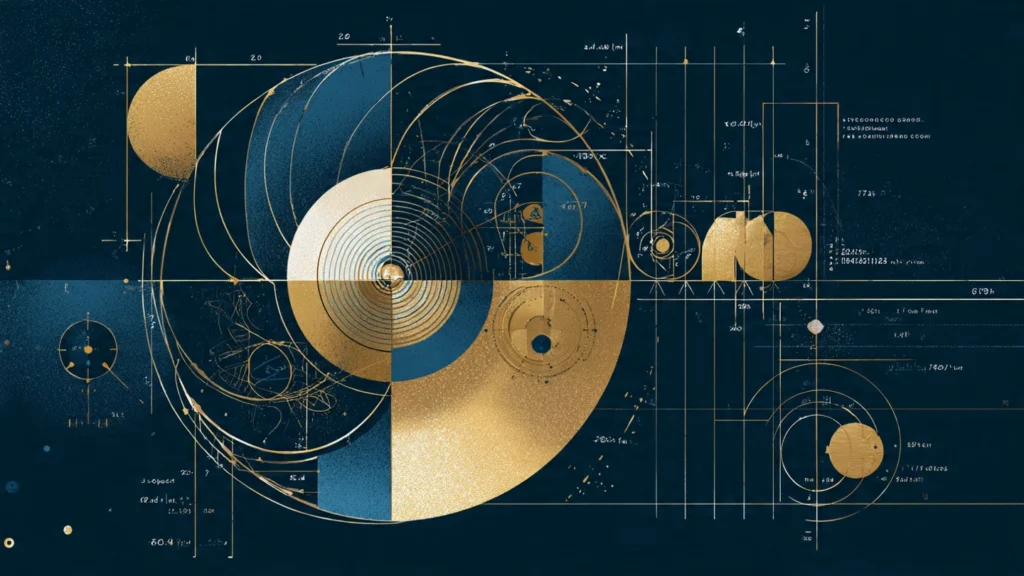
Also known as phi (φ), the divine proportion, or the golden mean, this magical number—approximately 1.618—appears throughout nature and has been used intentionally in some of humanity’s most celebrated designs.
What Exactly is the Golden Ratio?
The golden ratio is a special mathematical relationship that occurs when a line is divided into two parts. The ratio of the whole line to the larger part equals the ratio of the larger part to the smaller part. This always works out to approximately 1.618:1.
In simpler terms, if you have a rectangle where the length is 1.618 times the width, you’ve created a “golden rectangle”—a shape that humans find naturally pleasing to look at.
The Mathematical Formula
While you don’t need to be a mathematician to use the golden ratio, here’s the technical definition:
a/b = (a+b)/a = 1.618033988749…
This irrational number continues infinitely without repeating, much like pi.
The Golden Ratio in Nature
Before we discuss design applications, it’s fascinating to note that the golden ratio appears throughout the natural world:
- Flower petals often grow in quantities related to Fibonacci numbers (which approximate the golden ratio)
- Spiral shells like the nautilus follow golden ratio proportions
- Human faces considered most attractive often exhibit golden ratio relationships
- Hurricane formations and galaxy spirals follow this pattern
- DNA molecules measure 34 angstroms by 21 angstroms (a golden ratio)
This natural occurrence suggests our attraction to this proportion might be hardwired into our perception.
Why Designers Love the Golden Ratio
Designers across disciplines utilize the golden ratio for several compelling reasons:
1. Visual Harmony
Compositions based on the golden ratio create balance without appearing too rigid or symmetrical. There’s an organic quality that feels natural rather than forced.
2. Guides the Eye
The golden ratio helps create visual hierarchy, naturally directing the viewer’s attention to important elements in a design.
3. Timeless Appeal
Unlike trendy design techniques that come and go, the golden ratio has proven its effectiveness across centuries and cultures.
4. Mathematical Precision
For designers who want their work grounded in something more objective than “it just looks good,” the golden ratio provides a mathematical foundation.
Practical Applications in Different Design Fields
Graphic Design and Logo Creation
Many iconic logos incorporate golden ratio principles. Designers use golden circles and rectangles to create logos that feel balanced and memorable. The Twitter bird, Apple logo, and Pepsi logo have all been analyzed for their use of golden ratio proportions.
When designing a logo, you can overlay golden circles of decreasing size to create curves and shapes that naturally flow together.
Web Design and Layout
Web designers use the golden ratio to determine:
- Content width to sidebar ratios (often 1.618:1)
- Header heights relative to content areas
- Image sizes and placement
- Typography sizing (more on this below)
For example, if your main content area is 810 pixels wide, your sidebar could be 500 pixels (810/1.618 ≈ 500) for golden ratio proportions.
Typography and Text Hierarchy
The golden ratio is incredibly useful for creating type scales. If your body text is 16px, you might set your H2 heading at 26px (16 × 1.618 ≈ 26) and your H1 at 42px (26 × 1.618 ≈ 42).
This creates hierarchy that feels natural rather than arbitrary.
Architecture and Interior Design
From ancient Greek temples like the Parthenon to modern structures, architects have employed golden ratio proportions in:
- Room dimensions and ceiling heights
- Window and door placements
- Facade proportions
- Furniture arrangements
Photography and Composition
Photographers often use a variation called the “phi grid” (similar to the rule of thirds but with lines positioned at golden ratio divisions rather than thirds). Placing key elements along these lines or at their intersections creates more dynamic compositions.
The Golden Spiral: Bringing Motion to Design
The golden spiral (also called the Fibonacci spiral) is created by drawing arcs through golden rectangles. This spiral appears in nature and can be used in design to:
- Create flow and movement in a composition
- Guide the viewer’s eye through an image
- Determine placement of focal points
- Add dynamic energy to static designs
Many famous paintings, including Leonardo da Vinci’s works, incorporate golden spirals in their composition.
Tools and Techniques for Using the Golden Ratio
Digital Tools
Several tools make applying the golden ratio easy:
- PhiMatrix: Software overlay tool for any application
- Golden Ratio Typography Calculator: Online tools for type scaling
- Adobe Illustrator templates: Pre-made golden ratio grids
- Figma plugins: Various golden ratio helpers
Manual Calculation Method
If you prefer calculating manually:
- Start with a base measurement
- Multiply by 1.618 for the next size up
- Divide by 1.618 for the next size down
- Continue the sequence as needed
For example: 10, 16, 26, 42, 68, 110…
Common Misconceptions
“All Good Design Uses the Golden Ratio”
False. Many excellent designs don’t use the golden ratio at all. It’s one tool among many, not a requirement for good design.
“The Golden Ratio Guarantees Beauty”
Not exactly. While it can contribute to pleasing proportions, design involves many other factors: color, contrast, context, function, and cultural considerations.
“Historical Masterpieces Were All Designed Using the Golden Ratio”
Questionable. While some historical works do exhibit golden ratio proportions, scholars debate whether ancient artists consciously applied this principle or if we’re projecting these patterns onto their work retroactively.
When NOT to Use the Golden Ratio
The golden ratio isn’t appropriate for every design situation:
- When client requirements specify different proportions
- When brand guidelines dictate other measurements
- When accessibility standards require specific sizing
- When the content itself demands different proportions
- When creative expression benefits from breaking mathematical rules
Design is ultimately about solving problems and communicating effectively. Use the golden ratio as a helpful guide, not an inflexible rule.
Getting Started: A Simple Exercise
Want to experiment with the golden ratio in your next project? Try this:
- Choose a canvas: Start with a square or rectangle
- Divide it using 1.618: If your width is 1000px, divide by 1.618 to get approximately 618px
- Create a golden rectangle: Use these proportions for your main content area
- Add a spiral overlay: Place your focal point where the spiral tightens
- Scale your typography: Use the 1.618 multiplier for heading sizes
- Evaluate the result: Does it feel more balanced than your usual approach?
Conclusion: Balance Between Mathematics and Intuition
The golden ratio offers designers a time-tested framework for creating visually harmonious compositions. Whether you’re designing a logo, planning a website layout, or composing a photograph, understanding this principle gives you another tool in your creative toolkit.
However, remember that great design comes from balancing mathematical precision with human intuition, functional requirements, and creative vision. Use the golden ratio as a guide when it serves your purpose, but don’t let it constrain your creativity.
The most important question isn’t “Does this use the golden ratio?” but rather “Does this design communicate effectively and serve its intended purpose?”
As you continue your design journey, experiment with the golden ratio, observe where it works well, and develop your own instinct for when to apply it and when to try something different.